Pregnancy changes almost everything about how a body moves, carries load and manages pain, and those changes do not stop the moment a baby arrives. For many women, the physical journey through pregnancy and into the postpartum period is treated as something to simply get through, with little dedicated support beyond routine obstetric checks. Women’s health physiotherapy exists to fill that gap, offering targeted, evidence-informed care from the first trimester through to full postpartum recovery and beyond.
Why Pregnancy Physiotherapy Matters From the First Trimester
It is a common assumption that physiotherapy only becomes relevant once pain or discomfort has already set in during pregnancy. In practice, pregnancy physiotherapy is most useful when it starts early, while a program can still be preventative rather than purely reactive. As early as the first trimester, a physiotherapist can assess posture, movement patterns and core function, and begin building the kind of pelvic floor and core awareness that will matter increasingly as pregnancy progresses.
Early input also gives you a baseline. Understanding how your body moves and where it may be vulnerable to strain before the added weight and hormonal changes of later pregnancy makes it far easier to adjust as things change, rather than trying to problem-solve discomfort for the first time in the third trimester.
Common Pregnancy Complaints Physiotherapy Can Support
Lower back pain, one of the most frequently reported pregnancy complaints, often linked to postural shifts as the centre of gravity moves forward.
Pelvic girdle pain, which can affect walking, turning over in bed, or climbing stairs, and typically responds well to targeted assessment and management.
Rib and upper back discomfort as the ribcage expands to accommodate a growing baby.
Sciatic-type leg pain or nerve irritation, particularly in the second and third trimesters.
General deconditioning or uncertainty about which exercises remain safe as pregnancy progresses.
Preparing for Birth and Beyond
Beyond managing discomfort, pregnancy physiotherapy can help prepare the body for birth itself. This often includes pelvic floor awareness and relaxation techniques, breathing strategies, and guidance on positioning and movement that may support labour. It also means having a plan in place before birth for what postpartum recovery will look like, rather than trying to work it out for the first time while exhausted and adjusting to life with a newborn.
Having an existing relationship with a women’s health physiotherapist through pregnancy also makes the transition into postpartum physiotherapy far more seamless. Your practitioner already understands your history, your birth, and your goals, which removes much of the friction that comes with starting from scratch with a new provider during an already demanding period.
The Fourth Trimester: Postpartum Physiotherapy Priorities
The twelve weeks after birth, sometimes called the fourth trimester, is a critical window for postpartum physiotherapy, even though it is often the period when new mothers have the least capacity to prioritise their own care. A postpartum assessment typically covers pelvic floor function, abdominal separation, scar tissue if relevant, posture changes related to feeding and carrying a baby, and a safe, structured pathway back toward exercise.
This is also where the earlier work done during pregnancy tends to pay off. Women who have built pelvic floor and core awareness before birth often find the postpartum rebuilding process more intuitive, because the movement patterns and breathing strategies are already familiar rather than being introduced for the first time in a fragile, sleep-deprived state.
Why Brisbane Families Choose Local Women’s Health Physio
Consistency and convenience matter enormously during pregnancy and early parenthood, which is why so many Brisbane families look for a women’s health physio close to home rather than travelling across the city for appointments. Our Newmarket clinic is easily accessible for families throughout Brisbane’s inner north, including Grange, Wilston, Windsor, Ashgrove, Alderley, Kelvin Grove and Red Hill, making it straightforward to fit appointments around a young family’s schedule.
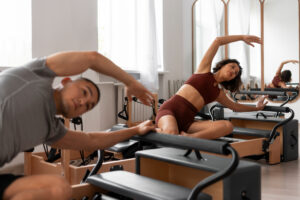
Being part of a local, established allied health practice also means women’s health physiotherapy does not exist in isolation. At All About Movement, our women’s health physiotherapists work alongside our osteopaths and Clinical Pilates instructors, so if your pregnancy or postpartum care also involves broader musculoskeletal support, that care can be coordinated under one roof rather than across several disconnected providers.
What Makes Women’s Health Physiotherapy Different From General Physio
Women’s health physiotherapists complete additional training specific to the pelvic floor, pregnancy and postpartum recovery, on top of their general physiotherapy qualifications. This means the assessment goes beyond a standard musculoskeletal review to include pelvic floor function, abdominal wall integrity, and the specific movement demands of pregnancy, birth and early motherhood.
It also means the advice you receive is grounded in what is actually appropriate for your stage of pregnancy or postpartum recovery, rather than generic exercise guidance that may not account for pelvic floor load, abdominal separation, or birth-related changes. This distinction matters, particularly in a period where misinformation about what is safe to do is common and often conflicting.
A general physiotherapist might treat a shoulder or knee in isolation, and do that well. A women’s health physiotherapist is trained to see the whole picture: how a changing centre of gravity affects the spine, how pelvic floor function relates to core strength, and how birth, whether vaginal or caesarean, changes the starting point for any rehabilitation plan that follows.
Signs It Might Be Time to See a Women’s Health Physio
Persistent lower back, pelvic or hip pain during pregnancy that is not improving with rest.
Any bladder or bowel leakage, at any point during pregnancy or after birth, regardless of how minor it seems.
Uncertainty about returning to exercise, lifting, or running after having a baby.
A visible or felt gap along the midline of the abdomen that has not resolved months after birth.
A general sense that something feels different or not quite right, even without a specific diagnosis in mind.
Booking Your Women’s Health Physio Appointment in Brisbane
Whether you are newly pregnant and want to start building good habits early, further along and managing discomfort, or well into postpartum recovery and ready to rebuild strength with confidence, women’s health physiotherapy has something to offer at every stage. There is no need to wait for a problem to become significant before booking an assessment.
If you are searching for women’s health physio in Brisbane’s inner north, our team at All About Movement in Newmarket is here to support you from pregnancy through to postpartum and beyond, with care that is personal, evidence-informed, and genuinely built around where you are in your own journey.